Car & auto detailing · Mesa, AZ
Car Detailing in Mesa, AZ
Auto detailing is a trade with a specific meaning: restoring and protecting the surfaces of a vehicle, inside and out, rather than making it temporarily look clean. In Mesa that means dealing with UV damage, mineral spotting and fine desert grit as much as ordinary dirt.
Everything here is performed mobile — at your home, apartment or workplace. If you want the specifics of how a mobile appointment works, see [mobile detailing](/mobile-detailing).
- Sedans, coupes, crossovers and EVs
- Interior, exterior or both
- Correction and coatings available
- Priced by condition, not by package name
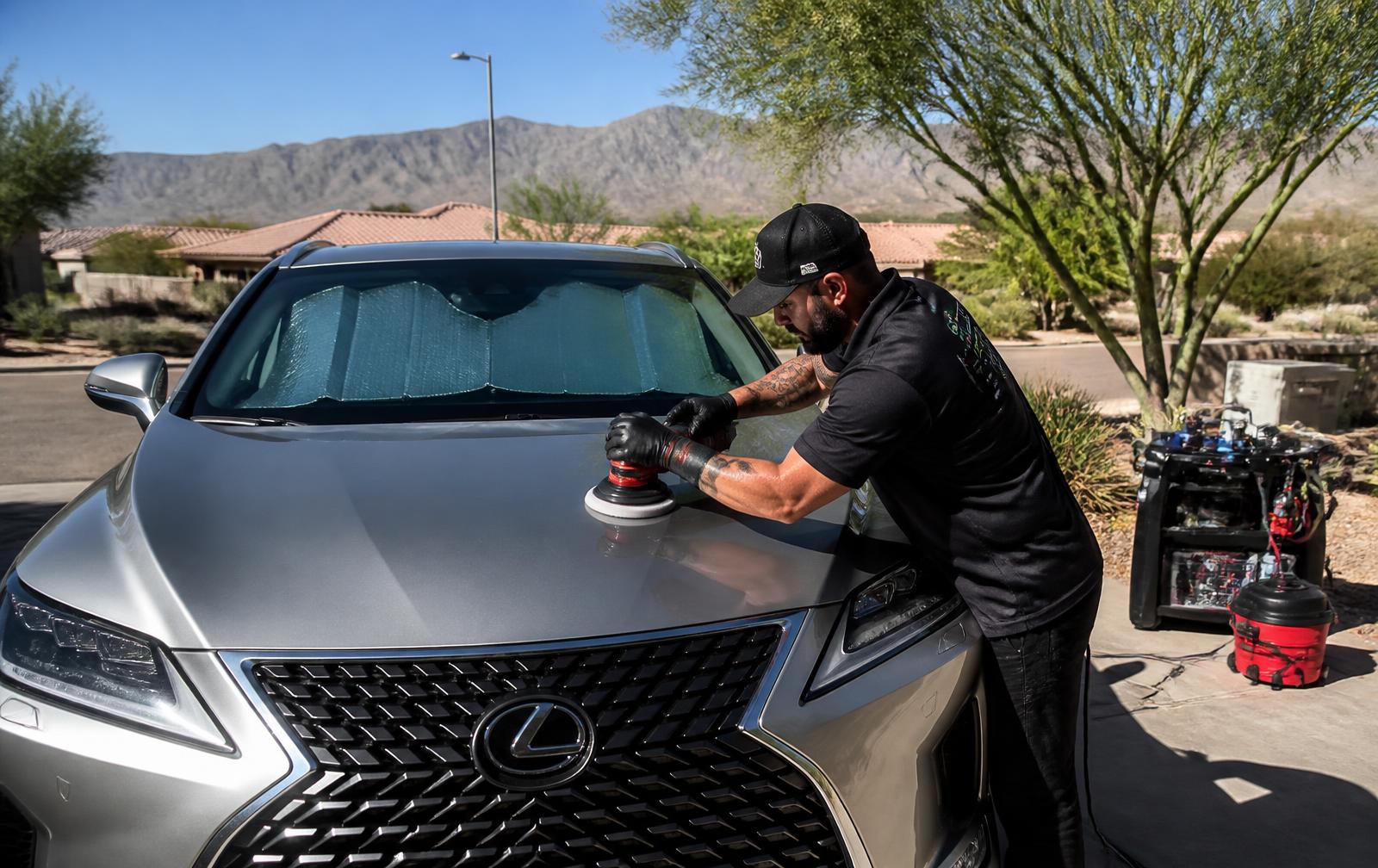
What detailing is, versus washing
A wash lifts loose dirt off a surface and leaves the condition of that surface unchanged. Detailing changes the condition itself: it pulls bonded contamination out of the clear coat, corrects defects that a wash could never touch, cleans contamination out of fabric and leather fibers, and finishes with a layer of protection that a wash does not add. Both have a place — a wash between appointments, detailing to actually reset and protect the vehicle.
The confusion mostly comes from marketing. A drive-through wash calling itself a 'detail package' is still a wash. If you are trying to work out which one your car needs right now, that distinction is usually the fastest way to decide.
What detailing covers
The work splits cleanly into four categories, and almost every quote is some combination of them. Cleaning removes what is on the surface. Decontamination removes what has bonded into it. Correction removes defects from the clear coat itself. Protection slows all of it down again.
A vehicle rarely needs all four at full strength. A well-kept two-year-old crossover mostly needs cleaning and protection. A ten-year-old commuter that has lived outdoors near the 60 may need all four. That is why an honest quote comes from looking at the car rather than from a printed menu.
- Cleaning — safe wash, wheels, interior vacuum, deep cleaning, glass: full car detailing
- Decontamination — iron fallout, mineral deposits, embedded grit: exterior detailing
- Correction — swirls, haze, oxidation, light scratching: paint correction
- Protection — sealant or ceramic coating, matched to how long you're keeping it
The different levels of service
Detailing is not one fixed service — it is a set of levels that go from a light refresh to a full mechanical reset. Understanding the levels is more useful than memorizing package names, because names vary by company and the same word can mean different things from one shop to the next.
- Wash-level. Loose dirt removed, no decontamination or correction. Covered under mobile car wash.
- Single-focus detail. Interior only or exterior only, for a vehicle that only needs one side addressed.
- Full detail. Interior and exterior together, cleaning and protection, no correction. The complete reset — see full car detailing.
- Correction-inclusive detail. A full detail plus machine polishing to remove clear-coat defects before protection goes on.
- Coating package. Correction followed by a multi-year ceramic layer instead of a shorter-lived sealant.
What Mesa does to a car specifically
Three forces dominate here. UV radiation degrades clear coat from above, which is why horizontal panels fade first on vehicles parked outdoors. Mineral-heavy water — sprinklers, tap rinses, monsoon rain over dust — leaves deposits that etch fastest on a hot panel. And fine desert particulate settles on everything, then gets wiped off dry, which is the single most common cause of swirl marks in the valley.
None of that is exotic; it just means the maintenance plan that works in a mild coastal climate is wrong here. Wash more often and more carefully, keep something protective on the paint, and deal with contamination before it etches rather than after.
Vehicle condition and what it changes
Condition drives both the plan and the outcome more than the vehicle's age does. A newer car that has been washed carefully and garaged most of the time may only need cleaning and protection. An older car that has lived outdoors, or one recently purchased with an unknown history, is more likely to need decontamination and correction as well, and the interior may need deeper attention regardless of exterior condition.
Some conditions are outside what detailing changes: clear coat that has already failed cannot be restored by polishing, since the process removes clear coat rather than adding it back. Odor from long-term contamination in porous foam sometimes reduces rather than fully resolves. Setting that expectation honestly at the quote stage avoids disappointment later.
Choosing a level
- Interior only — the vehicle looks fine outside but lives with kids, dogs or a commute: interior detailing
- Exterior only — paint feels rough, wheels are baked, interior is already tidy: exterior detailing
- Everything — it has been a year or more: full car detailing
- Keep it there — recurring shorter visits: maintenance detailing
Preparing for an appointment
Clearing personal items from the interior and mentioning anything unusual — pet hair, a spill, a strong odor — when you book helps the quote match the actual job. There is nothing else required on your end; the crew brings what the job needs to your location. For the logistics of that (space, access, property rules), see mobile detailing.
Larger vehicles and specialty cases
Trucks, three-row SUVs and vans are the same trade with different time blocks and access requirements — that lives on the truck and SUV detailing page. Motorhomes and trailers are a genuinely different workflow with different chemistry, covered under RV detailing. Company and work vehicles are covered under fleet detailing.
What it costs
Price follows labor, and labor follows condition. The main variables are vehicle size, how long since the last detail, interior contamination, whether the paint needs correction and which protection you choose. The full breakdown, including how to describe your vehicle so the quote holds, is in how much mobile detailing costs in Mesa.
Terms worth knowing before you call
- Swirl marks. Fine circular scratches in the clear coat, usually from wiping or automatic washing, visible mainly under direct sun.
- Oxidation. Dulling of the clear coat from long-term UV exposure — a haze rather than a stain, and not removable by washing.
- Iron fallout. Metal particles from brakes and roadways that embed in paint and rust, felt as roughness before they are visible.
- Overspray. Paint or coating mist from a nearby job that lands and dries on a vehicle's surface, distinct from ordinary dirt.
- Dwell time. How long a cleaning product sits on a surface before being agitated or rinsed — too short and it does nothing, too long and it can affect trim or rubber.
What detailing is not
Detailing is a cosmetic and protective trade, not a repair trade. It does not fix dents, cracked bumpers, or paint that has been scratched through to primer or metal — those are body shop work. It does not reupholster torn seats, replace worn carpet, or rebuild a headliner that is sagging from age; those are trim and upholstery repairs performed by a different specialist. And it does not repaint anything — correction works within the existing clear coat, it does not add new paint.
Where a vehicle needs both, the sensible order is usually repair first and detailing after, since sanding, filler work or panel replacement can undo detailing work done beforehand.
How neglect changes the scope
A vehicle that has sat outdoors for a year without a wash is not the same job as the same vehicle washed weekly over that year, even if both look reasonably clean on the surface. Neglect compounds: dust that could have been rinsed off becomes ground-in grit, water spots that could have been wiped away become etched into the clear coat, and interior dust that could have been vacuumed becomes packed into carpet fibers.
That is why an accurate quote depends on seeing the vehicle rather than hearing its make, model or age. Two identical cars with different histories can need very different amounts of work.
How to judge what your vehicle actually needs
A few quick checks at home narrow it down before you even call. Run a fingertip lightly over a clean panel — roughness usually means embedded contamination that a wash will not remove. Look at the paint under direct sun rather than shade — haze or fine circular marks that vanish in shade often reappear in full light. Check carpets and seats for anything beyond loose debris, since set-in stains and odor point toward interior work rather than a quick clean.
None of this replaces a walk-around quote, but it helps you describe the vehicle accurately when you call, which is the fastest way to get an estimate that holds.
Misconceptions worth clearing up
- "Detailing is just an expensive wash." A wash and a detail solve different problems; one removes dirt, the other changes the condition of the surface underneath it.
- "A more expensive package is always more thorough." Price should track the vehicle's actual condition, not a tier label — ask what specifically is included at each level.
- "Ceramic coating replaces washing." It changes how easily a wash goes, not whether one is needed. See ceramic coating vs wax for how the options compare.
- "All detailers do the same steps in the same order." Sequence matters — decontamination before correction, correction before protection — and skipping steps is usually how corners get cut invisibly.
Car detailing questions
What's the difference between car detailing and auto detailing?
How is detailing different from a car wash?
How often should I have my car detailed in Mesa?
Can you detail a leased vehicle before turn-in?
Do I need to choose a package, or can you just look at the car?
Is detailing worth it on an older or high-mileage car?
What terms should I know before calling?
Can detailing fix a scratch that goes through the clear coat?
Will detailing repair torn seats or cracked dash plastic?
What if I don't know how long it's been since my car was detailed?
Related services
Everything inside and out in one appointment.
Interior detailingCarpets, upholstery, leather, vents and glass.
Paint correctionRemoving swirls and oxidation from the clear coat.
Ceramic coatingLong-term protection for outdoor-parked vehicles.
How mobile service worksDetailing performed at your location in Mesa.
What it costsThe variables behind a detailing quote.
Get a straight answer on what your vehicle needs
Describe the vehicle and its condition and you'll get a realistic price range before anyone shows up.